Test a payment form
Check input masks, field lengths, expiration formatting and error messages without using real banking data. Review mobile layouts, client-side validation and submit-button behavior.
Free tool for developers and testers
Generate synthetic card numbers instantly for testing forms, prototypes and sandbox environments. This random credit card generator runs entirely in your browser: generated data is never sent or stored, and no number can make a real payment.
● Everything runs in your browser
For software testing only. This synthetic data does not work on merchant websites.
Test data — no real payment is possible.
Clean data without real-account risk
Check input masks, field lengths, expiration formatting and error messages without using real banking data. Review mobile layouts, client-side validation and submit-button behavior.
Add consistent sample data to a mockup, documentation page or product demo. Synthetic numbers create realistic layouts without exposing anyone’s personal or banking details.
Use this data only in development or test environments. Some payment providers accept only their official sandbox cards; consult their documentation when you need to trigger a specific result.
Simple and local
Choose a card type, quantity and output format. The generator creates synthetic data directly in your browser without contacting a bank, payment network or external service.
Generation happens in your browser. No generated number is sent to our server or stored by the application.
Format and limits
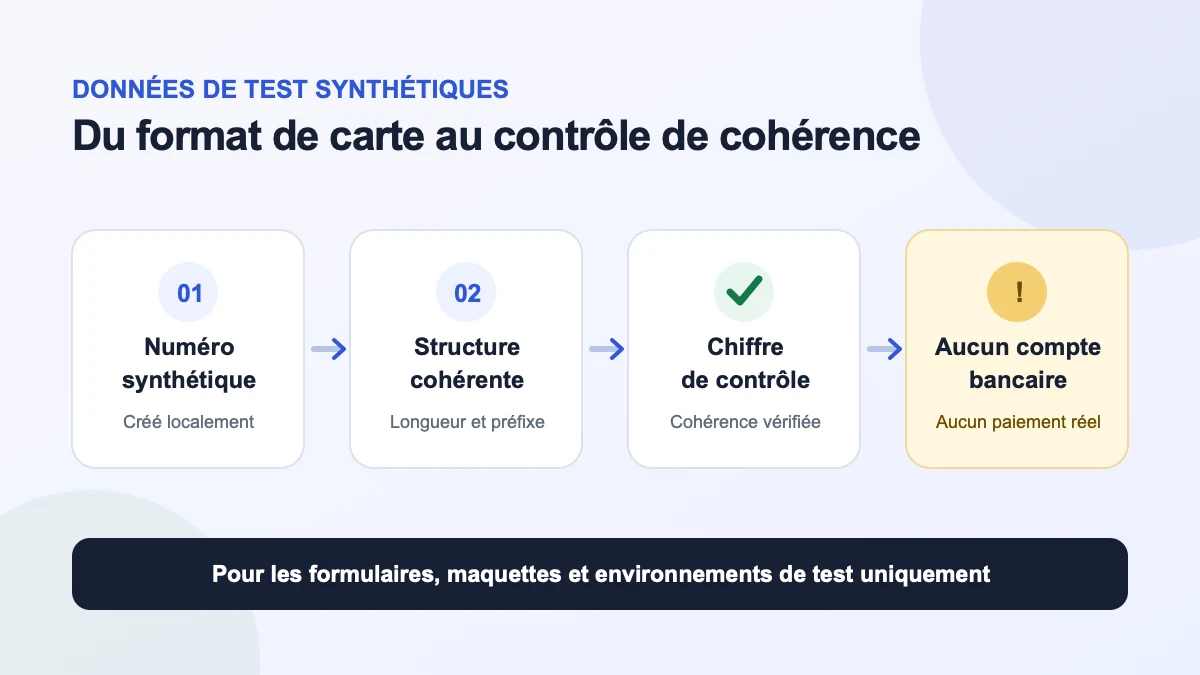
Each number follows the expected length and prefix for the selected card type. The final digit is calculated with the Luhn algorithm, which helps test common format checks in forms.
Each result also includes a future expiration date and a test security code. These fields help with prototypes and interface checks, but they are not issued by a bank.
Card, Text and JSON formats cover different workflows. Card helps verify visual presentation, Text is useful for quick copying, and JSON fits structured fixtures or development tools.
This validation is structural only. It does not verify a bank account, funds or payment-network authorization. Correctly formatted data still cannot complete a real transaction.
Understand the limit
Generated numbers follow card-number structure rules, including prefixes and the Luhn algorithm, to support form testing. They are not connected to real accounts. A real payment requires an issuer account, authorization and a payment-network response.
Generated numbers are synthetic test data. They follow card-number structure rules but do not correspond to real bank accounts and cannot make payments.
Clear answers
No. They are randomly generated synthetic data that follows formatting rules without being linked to an existing bank account.
No. They cannot make real payments and must never be used on a merchant website.
It helps test form layouts, length rules, input masks, demonstrations and compatible sandbox interfaces.
The Luhn algorithm is a checksum used to detect some input errors. Passing it does not prove that a card exists or can be charged.
No. Generation and formatting happen locally in your browser. The site does not store generated results.
Choose Card to inspect a card layout, Text for quick copying, and JSON for structured fixtures, automated tests or prototypes.
This is synthetic format-testing data. For payment scenarios, use the specific official test cards documented by your provider.
A sandbox may accept only test numbers issued by its provider. Use the provider’s official documentation to trigger the intended payment scenarios.
This generator supports format and interface testing. Official provider cards may additionally simulate events such as approval, decline or authentication.
No. This site does not enable bypassing subscriptions, payment verification or service terms.
Key takeaway
This random credit card generator is designed for forms, mockups and development environments. Treat every result as synthetic data and use your provider’s official cards whenever you test a real payment flow in a sandbox.
No account is required. We do not ask for or collect real banking details, and generated results are neither sent nor stored by the application.
This service is limited to software testing, education and demonstrations.